tune page
Wild mountain Thyme
Found in scotland.abc
from the John Chambers abc collection


X:281
T:Wild mountain Thyme
T:Go Lassie, Go
T:The Braes o Balquhidder
T:Will you go Lassie go
O:scotland
C:anon.
M:4/4
L:1/8
K:C
c2A2 |G3G A2c2|cc3 e2g2|a3g a2g2|
eg3 e2g2|a4 g2e2|d-c3 d2e2|f3e d2c2|
Ac3 c2A2|G4 A2c2|c4 e2g2|
a3-g a2g2|eg3 e2g2|a4 g2e2|d-c3 d2e2|
f3e d2c2|Ac3 c2A2|G4 A2c2|c4 ||
W:
W:Oh the summer time is coming
W:and the leaves are sweetly blooming
W:and the wild mountain thyme
W:grows around the blooming Heather
W:
W:Chorus:
W:
W:Will you go lassie go
W:And we'll all go together
W:Where the wild mountain thyme
W:Grow around the blooming heather
W:
W:I will build my love a bower
W:By yon clear crystal fountain
W:and on it I will pile
W:all the flowers of the mountain
W:
W:will ye go lassie ....
W:
W:And if my love should leave me
W:I would surely find another
W:to pull (or pluck) wild mountain thyme
W:all around the blooming heather
W:
W:Will ye go lassie go ...
M:6/8
2/4/94
INTRODUCTION
This file contains a number of well-known Irish jigs, reels,
hornpipes, and polkas, written out in Chris Walshaw's abc notation. To
print them out, first process the file with the program abc2mtex,
which will convert it to a Music TeX file, and then run that file
through Music TeX. See the abc2mtex documentation for an explanation
of the notation. Both abc2mtex and Music TeX are available for anonymous
ftp on the archive celtic.stanford.edu.
Like any folk music, these tunes change with time. There may be
quite different versions of some of them floating around. I have tried
to give settings which are close to what I hear played. A few tunes
are transcribed from particular performances, one or two others are
taken from books--both of these are indicated on the tune notes--but the
majority are set about as I have heard them played.
Quite a lot is left to the player. The settings are basic: the only
decorations indicated explicitly are rolls, triplets and quadruplets;
first and second endings are only written out when they are
substantially different. Apart from the fact that most players don't
need to be told when and where to put in a grace note, a lot of gracings
are done differently on different instruments: carefully-written-out
fiddle decorations can be a distraction to someone playing the tune on a
flute. Since the decorations are only indicated generically, not in
detail, the tunes should be playable on any of the usual instruments.
(Well..I have only checked them out on the whistle and pipes.) If some
of the details of the settings turn out to be awkward on a particular
instrument, just adapt the tune to fit--most players automatically
modify a tune slightly in order to make it fit the fingers, or to take
advantage of some particular effect on their instrument. (There are a
couple of obvious cases, where, for instance, the range is beyond the
range of the pipes, whistle, and flute. It is up to the individual to
modify the setting--i.e. to fake it--if they want to play it.)
One thing bears noting: I have written the hornpipes out in
straight eighth notes, but they are usually played with alternating
dotted and cut notes: i.e. what I have written as "eighth, eighth,
eighth, eighth" is often played more like "dotted eighth, sixteenth,
dotted eighth, sixteenth." The amount of emphasis is a matter of
style, so some books write out the dotted notes, others don't. I opted
for the easiest path, and wrote them out in straight eighths.
Thanks to Dan Beimborn and Seamus Keleher for suggesting
many of these tunes. (Cryptic notations such as Z:Boston just indicate
that the tune is commonly played in sessions there.  But in fact, most of
these tunes will be played in sessions all over.)
I make apologies in advance for the typos which have surely
escaped my proof-reading. Please let me know about any obvious errors,
or any settings which seem too much at variance with what is played in
your own area.
When I knew the composer of a tune, I indicated it, but I only knew
the composers of a couple of the tunes. If any others have known
composers, I would appreciate hearing about it. As far as I know, the
remainder of the tunes are public domain. The copyright below does not
cover the tunes themselves, just the arrangements and the code in this
file.
Tune 35 is from Bulmer and Sharpley' book; tune 15 from Ceol
Rince na hEireann, tune 49 from Leo Rowsome's tutor, tune 4 from
O'Neill's. The remainder of this file is copyright by John B. Walsh,
January, 1994. It may be freely used, copied and distributed, as long as
this notice is included with the copy. It may not be sold, or used to
make hard copies for sale, without express permission of the author.
DOUBLE JIGS
Visitors to this tune page also viewed:
Red-Haired Mary
tune page browse similar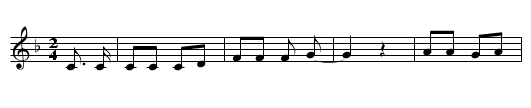
The Stick Across The Hob
tune page browse similar
Reel Du Vieux Moulin
tune page browse similar